Hannah Baker—Ryan Shaver
Thirteen Reasons WhyHannah Baker’s relationship with Ryan Shaver is a story of recognition undone by exposure. In the school poetry group, they find a shared wish to write about happiness and build trust by exchanging their notebooks; Ryan then reads the hidden meaning in a poem Hannah herself has not fully understood. But he later takes that poem from her notebook and prints it in the Lost-N-Found Gazette. What first felt like intimate attention becomes a breach of confidence, and Hannah’s private attempt to speak to herself is turned into material for public interpretation and mockery.
Meeting in the Poetry Group
Ryan is introduced as the editor of the school’s Lost-N-Found Gazette and as a high school student whose perspective is admired by older poets. Hannah and Ryan meet through the poetry group, where their early connection grows not from instant intimacy but from recurring conversations after the weekly sessions. They sit on the library steps and laugh at the poems they have heard, finding them so depressing that the group’s name and stated purpose seem at odds with its mood.
They discover that they both joined for a similar reason: they want to write happy poems, poems about loving life, rather than read them aloud to what Hannah describes as a depression-loving group of poets. Their private exchange gives that preference a space of its own. After the meetings, they explain their poems line by line, making the steps a setting for careful attention rather than the group’s more public performance.
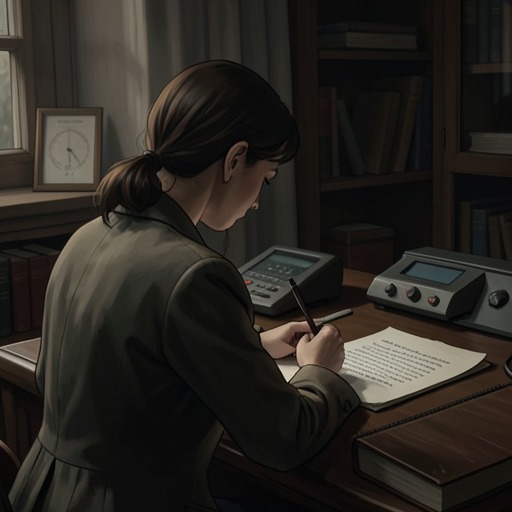
By the third week, their trust has advanced enough for them to take a risk: they hand each other their entire poetry notebooks. They spend two hours on the concrete steps, with the sun going down, turning pages. For Hannah, the act is courageous. Ryan’s writing moves her; she feels the emotions in his poems even when she does not understand exactly what they mean. Reading his work also makes her reconsider her own, as she feels she has spent too little time choosing words with comparable emotional force.
A Poem Read More Clearly Than Its Author
One of Hannah’s poems catches Ryan’s attention, and he asks when she wrote it. She does not tell him. His question opens a more personal conversation: Ryan proposes that the poem is not about Hannah’s mother or a boy, but about Hannah herself—a letter to herself concealed within a poem. Hannah flinches, becomes defensive and angry, then recognizes that Ryan has found a meaning she could not see in her own writing. His reading frightens and saddens her precisely because it makes the poem newly legible to its author.
Ryan’s interpretation also gives their exchange a distinctive intimacy. He tells Hannah that no boy is overlooking her more than she is overlooking herself, as he understands the poem. Hannah later accepts that the poem went much deeper than his initial explanation. In that moment, being read is not simply being judged: Ryan’s attention helps her recognize what her words disclose about her own interior life.
That recognition makes the later betrayal more consequential. Ryan has demonstrated that he can approach the poem as a private communication whose meaning exceeds easy explanation. Yet he takes it from Hannah’s notebook and publishes it in the Lost-N-Found Gazette, despite having called it scary. Hannah stresses that it was never a lost poem and that Ryan had not found it in any sense that gave him a right to claim it. Their earlier sharing of notebooks had been an act of mutual trust, not permission to circulate one of her poems.
Publication and the Breach of Trust
Once the poem appears in Ryan’s collection, it reaches an audience far beyond the two students who had read each other’s work on the library steps. Teachers find it before poetry lessons, and entire classrooms take it apart in search of meaning. In Hannah’s class, no one interprets it correctly—not even Mr. Porter—although everyone believes they have. The poem that Ryan had read with unusual insight becomes a public text over which Hannah has lost control.
The classroom framing sharpens the injury. Before distributing the poem, Mr. Porter compares reading work by an unknown student to reading a classic poem by a dead poet: neither author can be asked about the true meaning. Hannah’s poem is thus treated as an object for interpretation rather than as words belonging to a living student who could answer back. That comparison becomes especially bitter because Hannah is alive, and because Ryan had encountered her and her notebook directly before making her work available to others.
Students do not merely search for meaning; they cut up and make fun of the poem. Its publication converts a shared confidence into material for scrutiny, and Ryan’s role as editor gives the breach a public channel. Hannah’s grievance is therefore not that he failed to understand her writing. He understood enough to identify its private significance, then helped place it where other people could misread, dissect and ridicule it.
Recognition, Rumor, and the Larger Pattern
The relationship sits within a wider pattern in which other people’s accounts of Hannah reshape how she is treated. Elsewhere in the tapes, she recalls that a rumor based on a kiss damaged a memory she had hoped would be special, helped establish a reputation others believed, and acquired a snowball effect. The poem episode repeats the movement in a different form: something personal passes into circulation, acquires meanings beyond Hannah’s control, and becomes a basis for other people’s reactions.
Hannah’s account also places Ryan’s action beside the sexualized reputation Alex’s list helps reinforce. She argues that once some people are told she has the best ass in the freshman class, they feel licensed to treat her as nothing but that body part. The episode involving Ryan is not the same kind of objectification, but it shares the underlying loss of agency: in one case her body, and in the other her words, are made available for public consumption. The poem’s circulation shows how exposure can injure even when it begins with someone who has genuinely listened.
The distinction between the Ryan who recognizes Hannah in her poem and the Ryan who prints it is central to the relationship. His early insight does not erase his later choice; it makes the breach harder to reconcile with the trust they built. Through that reversal, Hannah’s story presents attention as ethically incomplete unless it respects the boundaries of what has been shared. Ryan once helps her see herself in her writing, but his publication leaves her to watch that writing pass into other people’s hands and interpretations.